

First responders are tactical athletes. Whether you wear turnout gear, a duty belt or a medic vest, your body must be ready for unpredictable, high-intensity physical demands at any hour. Yet the erratic nature of shift work makes structured fitness notoriously difficult to maintain. This guide provides a complete framework for programming functional training that addresses the four pillars every first responder needs: strength, endurance, mobility and recovery.
Why First Responders Need a Different Approach to Fitness
Traditional bodybuilding splits—chest-and-triceps Monday, legs Wednesday—fail first responders because the job never isolates a single muscle group. Dragging a charged hose line up a stairwell, extricating a patient from a vehicle or sprinting to a scene in body armor all demand integrated, whole-body effort.
Members of law enforcement, the fire service and EMS are increasingly recognised as tactical athletes who require programming that addresses mobility, movement efficiency, aerobic capacity and power rather than isolating individual muscles. Exercise programs for first responders should therefore take a multi-component approach that mirrors the real-world demands of the job.
Critically, first responders face higher rates of cancer, obesity, diabetes, heart conditions and injuries than the general population, along with elevated risk of mental-health issues. A proactive fitness strategy is not optional—it is a career-longevity tool.
Pillar 1 — Functional Strength Training
Why It Matters on the Job
Strength training is essential to increase your physical capacity to push, pull, lift, carry and manipulate loads safely. On routine days it reinforces your musculoskeletal bracing system, protecting spinal alignment under the weight of turnout gear or Kevlar. On high-call-volume days, maximum muscular strength gives you the capacity to perform demanding rescue tasks without hesitation.
Programming Principles
- Prioritise compound, multi-joint movements. Deadlifts, goblet squats, lunges, pull-ups and presses replicate the pushing, pulling, climbing and carrying patterns you perform on scene. Isolation curls and machine fly sets have a limited role.
- Follow a periodised progression. Effective programs develop stability first, then strength, then power. Skipping the base-building phase—as some high-volume random-WOD approaches do—increases injury risk.
- Target common weak links. Nearly 50 percent of fire-rescue athletes will injure their back on duty, and low-back pain is the number-one reason firefighters retire early. Focus on developing the glutes, hamstrings, hips, shoulder girdle and deep core musculature.
- Include loaded carries. The farmer’s walk targets grip strength, forearms, shoulders and core muscles—all crucial for maintaining control while handling equipment or performing rescues—and it improves overall body coordination and strength endurance.
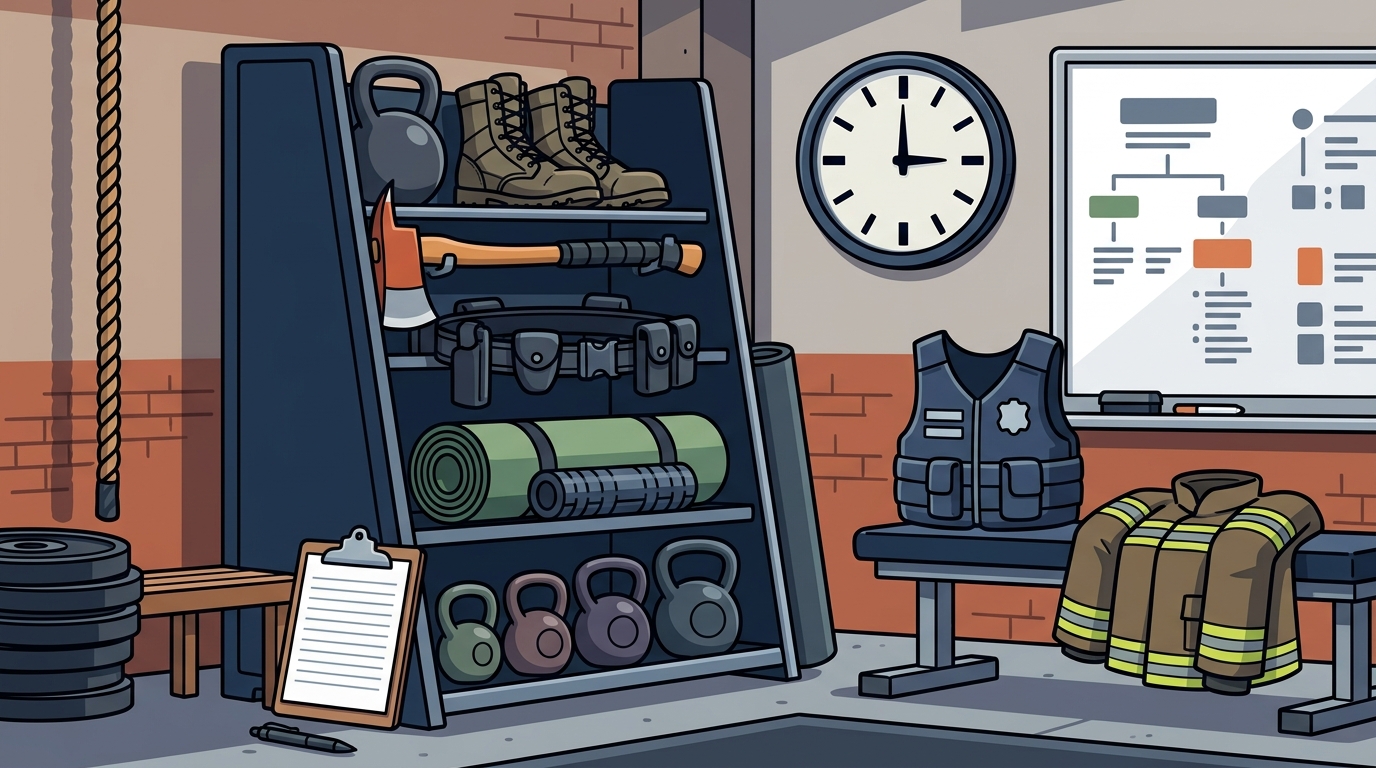
Sample Strength Session (40–50 min)
| Exercise | Sets × Reps | Rest |
|---|---|---|
| Trap-bar deadlift | 4 × 5 | 90 s |
| Goblet squat | 3 × 10 | 60 s |
| Bent-over dumbbell row | 3 × 8 each arm | 60 s |
| Standing dumbbell press | 3 × 8 | 60 s |
| Farmer’s carry | 3 × 40 m | 60 s |
| Pallof press (anti-rotation core) | 3 × 10 each side | 45 s |
Pillar 2 — Cardiovascular Endurance and Work Capacity
Aerobic Base + Anaerobic Intervals
Fire-rescue athletes need a solid level of aerobic fitness, but they cannot overlook the value of challenging the anaerobic systems. An effective program builds a cardiovascular base first and then layers in high-intensity interval training (HIIT).
HIIT closely mimics the unpredictable, demanding nature of emergency-service work, where you must exert maximum effort at a moment’s notice. It improves cardiovascular fitness, endurance and overall conditioning, and also builds the mental toughness and fatigue resilience that are critical on the fireground or emergency scene.
Practical Conditioning Options
- Steady-state aerobic work (2 sessions per week): 20–30 minutes of running, rowing, cycling or stair climbing at a conversational pace. This develops the aerobic engine that fuels recovery between high-intensity bursts on scene.
- HIIT / metabolic conditioning (1–2 sessions per week): Short, intense intervals such as 30-second sled pushes, assault-bike sprints or station-stairwell repeats, followed by equal or double rest periods. Exercises like tire drags, sledgehammer strikes, crawls and sprint-carry combinations transfer directly to fireground tasks.
- Micro-conditioning on shift: When a full gym session is not feasible, short one-to-fifteen-minute bursts of movement—sometimes called “exercise snacking”—can be done in the spaces you already occupy. Think squats in the bay, push-ups after report writing or a quick stair climb before the next call.
Pillar 3 — Mobility and Movement Preparation
The Overlooked Career-Saver
Many first responders deal with lower-back pain, knee issues and shoulder strain, often due to years of repetitive motion and sudden physical demands. Incorporating active mobility exercises improves joint stability, flexibility and range of motion in the hips, shoulders and spine, allowing you to move more efficiently during critical situations and reducing injury risk.
Key Mobility Practices
- Active warm-ups before every session. Dynamic movements such as leg swings, hip circles, inchworms and band pull-aparts prepare the body for movement by boosting heart rate, blood flow and core temperature while improving nervous-system function.
- Foam rolling (self-myofascial release). Using your body weight to apply pressure on trigger points within a muscle releases tension in the fascia, improves overall mobility and range of motion, and reduces injury risk. Spending a few minutes rolling calves, quads, hamstrings and glutes at the start of a shift pays dividends.
- Targeted movement flows. The “Spiderman” lunge variation is a favourite among fire-service coaches for opening up hip mobility. Pair it with thoracic-rotation drills and shoulder CARs (controlled articular rotations) for a five-minute routine you can do in uniform.
- Annual movement screening. Some departments use the Functional Movement Screen on an annual basis to assess asymmetries and limitations, then build corrective mobility and stability work around findings.
Pillar 4 — Recovery: The Forgotten Training Session
Why Recovery Is Non-Negotiable
Recovery and planning are just as important as a good workout. This is especially true on shift days: it does not make sense to perform a gruelling workout when the alarm could send you into action at any moment. Lighter activity on duty—and intentional rest on off days—allows the body to adapt and grow stronger.
Recovery Strategies for Shift Workers
- On-shift recovery sessions: Light cardio intervals, core or rehab exercises, foam rolling and stretching keep the body active without creating excessive fatigue.
- Sleep hygiene: Aim for 7–9 hours of quality sleep whenever your rotation allows. Use blackout curtains, limit screens before bed, and keep the room cool. Poor sleep sabotages every other training pillar.
- Nutrition timing: First responders need to combine cardio training, functional resistance training and a sound diet for the best performance gains. Prioritise protein within 60 minutes post-training, stay hydrated throughout a shift, and minimise processed foods that spike inflammation.
- Mental-health micro-resets: Just a few minutes of targeted physical activity has been shown to lower cortisol levels, reduce anxiety symptoms and improve mood by triggering the release of endorphins, dopamine and serotonin. Even brief movement resets the nervous system during a stressful shift.
Putting It All Together: A Sample Weekly Schedule
This template is based on a common 24-on / 48-off rotation but can be adapted to any shift pattern. The key principle: perform higher-intensity work on off days and keep on-shift training moderate.
| Day | Focus | Duration |
|---|---|---|
| Off-Day 1 (e.g. Sunday) | Full-body strength or metabolic workout | 45–55 min |
| Off-Day 2 (e.g. Monday) | HIIT / cardiovascular intervals + mobility flow | 35–45 min |
| On-Shift (e.g. Tuesday) | Foam rolling, light stretching, micro-exercises between calls | 10–20 min cumulative |
| Off-Day 3 (e.g. Wednesday) | Full-body strength (different emphasis) + steady-state cardio | 50–60 min |
| Off-Day 4 (e.g. Thursday) | Active recovery — walk, yoga, swim or recreational sport | 30–45 min |
| On-Shift (e.g. Friday) | Light interval cardio, core work, foam rolling | 10–20 min cumulative |
| Rest (e.g. Saturday) | Complete rest or light mobility work | 0–15 min |
Equipment-Minimal Station Workout
Many firehouse or precinct gyms have limited equipment. Here is a 25-minute session requiring only a pair of dumbbells and your bodyweight:
- Warm-up (3 min): Jumping jacks → hip circles → arm circles → Spiderman lunges
- Strength circuit (3 rounds, 45 s work / 15 s rest):
- Dumbbell goblet squat
- Push-up (feet-elevated for challenge)
- Single-arm dumbbell row
- Reverse lunge with dumbbell
- Dumbbell floor press
- Finisher (2 rounds): 30 s farmer’s carry → 30 s bear crawl → 30 s rest
- Cool-down (3 min): Foam roll quads, lats and thoracic spine → 90/90 hip stretch each side
Common Mistakes to Avoid
- Skipping the base-building phase. Jumping straight into heavy lifts or advanced HIIT without developing stability first leads to injury.
- Neglecting mobility. Flexibility training is not a luxury. The more flexible the muscle and joint, the better the first responder recovers and the lower the chance of injury.
- Training to failure on shift. Your primary duty is response readiness. Save peak-intensity work for off days.
- Ignoring mental-health benefits of movement. Exercise is one of the most effective stress-management tools available. Even micro-sessions on shift contribute to emotional resilience.
- Following a generic bodybuilding split. There are no isolating movements on the fireground, and therefore functional training must take a full-body approach.
Key Takeaways
- First responders are tactical athletes who need programming that addresses strength, endurance, mobility and recovery simultaneously.
- Compound, functional movements—deadlifts, squats, rows, carries, crawls—transfer directly to job tasks.
- Periodisation matters: build stability, then strength, then power.
- HIIT is essential because it mimics the stop-and-go intensity of emergency work.
- Mobility and foam rolling protect against the lower-back, knee and shoulder injuries that plague long careers.
- Recovery is a training session in itself—especially on shift days.
- Micro-exercise “snacking” throughout a shift adds up and supports both physical and mental health.
Frequently Asked Questions
How many days per week should a first responder train?
Three to four structured training sessions per week is a sustainable target, supplemented by light mobility work and micro-exercise on shift days. A well-designed program balances two or three strength days with one or two dedicated conditioning days.
Can I get a good workout with minimal equipment at the station?
Absolutely. A pair of dumbbells and your bodyweight are enough for effective training. Exercises like goblet squats, push-ups, rows, farmer’s carries and bear crawls require almost no equipment and closely replicate on-the-job movement patterns.
Is CrossFit a good choice for first responders?
High-intensity functional training can be beneficial, but programmes must follow a developmental progression—stability, then strength, then power. Random high-volume workouts without a periodised base have been associated with increased injury rates. Look for a coach who understands tactical-athlete programming.
How do I stay consistent with an unpredictable shift schedule?
Plan your highest-intensity workouts on off days and use on-shift time for lighter recovery-focused movement. Short micro-exercise sessions of one to fifteen minutes can be done in uniform in the spaces you already occupy—no gym required. Setting a personal goal such as five micro-exercises per shift helps reinforce the habit.
Why is mobility training important for first responders?
Many first responders develop lower-back pain, knee issues and shoulder strain from years of repetitive motion and sudden physical demands. Active mobility exercises and foam rolling strengthen stabilising muscles and improve range of motion, helping prevent the most common on-the-job injuries and extending career longevity.