
Traditional Bodybuilding vs. Functional Fitness for First Responders: Which Training Method Actually Prepares You for the Job?
Walk into any firehouse gym and you will hear someone ask the classic question: How much do you bench? It is a fair question in a commercial gym, but for people whose lives—and the lives of others—depend on physical performance, the answer matters far less than you might think. This comparison breaks down traditional bodybuilding and functional fitness through the lens of what first responders actually need on the job.
The Physical Demands First Responders Actually Face
Before comparing training styles, you need to understand what the job actually requires. First responders are not judged by a one-rep max on a platform—they are judged by what they can do when a call comes in at 2 a.m.
Firefighters, law enforcement officers, EMTs, and paramedics face an overlapping set of physical challenges: lifting and carrying victims, dragging charged hose lines up stairwells, sprinting to a scene, wrestling a suspect into custody, or performing CPR for extended periods under extreme stress.
The Candidate Physical Ability Test (CPAT), used by departments across the country, illustrates this perfectly. It consists of eight continuous events—stair climbing with a weighted vest, hose dragging, equipment carrying, ladder raises, forcible entry simulation, search tasks, victim rescue dragging, and ceiling breach—all completed within a 10-minute-20-second time cap. These tasks demand strength, endurance, power, balance, and grip all at once—not in isolation.
As one fitness resource puts it, first responders must handle tasks where nothing comes in a neat, balanced package. The loads are awkward, the terrain is unpredictable, and heart rates are through the roof before the physical work even begins.
What Traditional Bodybuilding Brings to the Table
Traditional bodybuilding—training that isolates individual muscle groups across dedicated sessions (chest day, back day, leg day)—is the most common style of training in commercial gyms. It has real strengths:
- Muscular hypertrophy: Bodybuilding is unmatched for building muscle size, which can contribute to raw strength.
- Structured progression: Programs follow clear periodization, making it easy to track gains week to week.
- Injury rehabilitation: Isolation movements are excellent for targeting weak links and rehabilitating specific injuries.
- Body composition: Improved body composition through resistance training supports cardiovascular health.
However, there is a critical gap. Bodybuilding trains muscles, not movements. A firefighter with an impressive bench press may still struggle to drag a 185-pound dummy 50 feet, because that task demands coordinated full-body effort under cardiovascular stress—not isolated pectoral strength.
Fitness experts working with tactical populations have noted this disconnect clearly. Exercise programs designed around one body part or muscle group at a time are fundamentally mismatched with the multi-joint, multi-plane demands first responders face in the field.
The Case for Functional Fitness
Functional fitness trains movements rather than muscles. It prioritizes compound exercises, multi-plane coordination, and conditioning that mimics job-specific tasks.
Retired Fire Chief Dan Kerrigan recommends replicating movement patterns used on incident scenes, arguing that this approach conditions the body to better withstand the specific challenges responders face. He notes that functional training not only improves incident-scene performance but also reduces injury risk and decreases recovery time after strenuous work.
Research supports this position. Training that mimics the real-life demands of the job—lifting, carrying, and dragging—has been shown to boost on-the-job performance and may be more effective at preventing back injuries than traditional strength training alone. High-intensity functional training (HIFT) in particular has been proven to significantly improve the kind of fitness firefighters need by hitting multiple areas—strength, power, endurance—simultaneously.
Why Functional Fitness Suits Shift Schedules
First responders do not have the luxury of two-hour gym sessions five days a week. Between unpredictable calls, long shifts, and limited downtime, fitting in structured training is a constant challenge. HIFT-style workouts are time-efficient because they combine strength and conditioning into a single session—making them especially practical for 24- or 48-hour shift rotations.
Head-to-Head: Six Performance Categories Compared
| Performance Category | Traditional Bodybuilding | Functional Fitness | Edge |
|---|---|---|---|
| Raw Maximal Strength | Strong—isolation builds individual muscle capacity effectively | Good—compound lifts (deadlifts, squats, presses) still build significant strength | Slight edge: Bodybuilding (for pure hypertrophy) |
| Muscular Endurance Under Load | Limited—high-volume pump sets do not replicate sustained exertion with awkward loads | Strong—sandbag carries, sled drags, and farmer walks build task-specific endurance | Clear edge: Functional Fitness |
| Cardiovascular / Work Capacity | Weak—bodybuilding programs generally neglect conditioning | Built in—HIFT and circuit formats keep heart rate elevated throughout the session | Clear edge: Functional Fitness |
| Mobility & Injury Prevention | Moderate—depends heavily on individual programming; many bodybuilders skip mobility work | Strong when programmed well—most tactical fitness programs include mobility and Functional Movement Screens | Edge: Functional Fitness |
| Power & Explosiveness | Weak—slow, controlled reps are the norm; explosive movements are rare | Strong—kettlebell swings, box jumps, med ball slams, and Olympic lift variations train rate of force development | Clear edge: Functional Fitness |
| Core & Stabilizer Strength | Limited—machines and benches remove the need for stabilization | Excellent—unilateral work, sandbags, and ground-based movements demand constant stabilization | Clear edge: Functional Fitness |
The scorecard is lopsided, but it does not mean bodybuilding has no role. The nuance matters—and the best real-world programs understand that.
The Hybrid Approach: Why the Best Programs Use Both
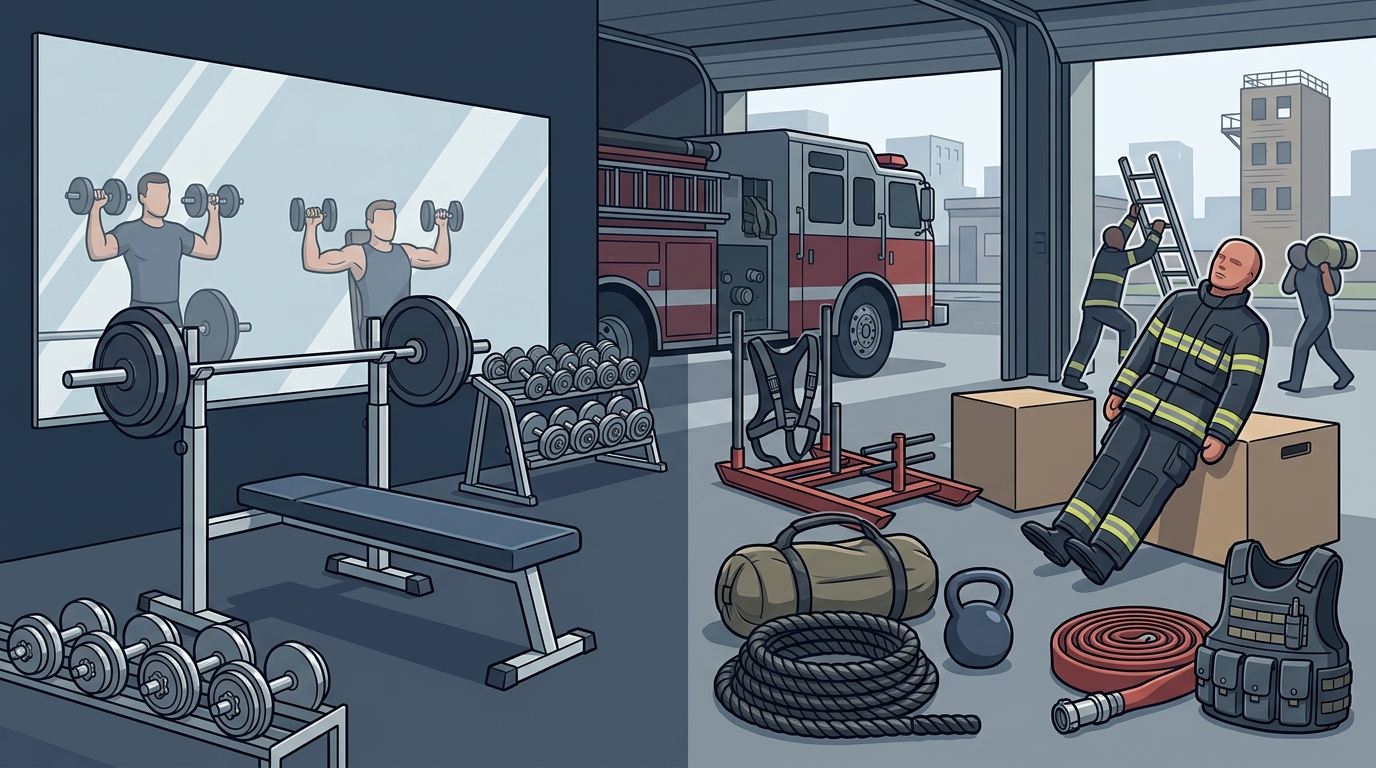
The most effective first responder training programs do not choose one camp and ignore the other. They build a foundation of muscular strength—using compound barbell lifts that overlap with bodybuilding—and then layer functional, job-specific work on top.
The Firehouse Strength & Conditioning program, designed by NSCA-certified coach and senior firefighter Eric Haskins, uses a Conjugate Method and Concurrent Training Model. Its goals: build maximal strength, develop explosive power, and increase work capacity while simultaneously reducing the risk of on-duty injury. The equipment list is telling—barbells and plates alongside kettlebells, sandbags, sleds, and air bikes.
A well-designed first responder gym needs to cover four bases: heavy strength work, job-task simulation, efficient conditioning, and injury prevention. That means starting with a rack, barbell, bench, and dumbbells for building strength, then adding sleds, sandbags, and kettlebells for functional work, and rounding it out with conditioning tools like air bikes or rowers.
Where Bodybuilding Movements Fit In
Accessory lifts borrowed from bodybuilding—dumbbell rows, face pulls, lateral raises, bicep curls—serve a valuable purpose when used strategically:
- Injury prehab: Strengthening rotator cuff muscles, rear delts, and grip helps prevent common shoulder and elbow injuries.
- Addressing imbalances: Isolation work targets weak muscles that compound movements may miss.
- Rehabilitation: Post-injury, isolation exercises allow targeted strengthening without loading the entire kinetic chain.
The key is proportion. In a first responder program, accessory bodybuilding movements should support the functional work—not replace it.
Sample Weekly Training Split for First Responders
This template balances strength, functional training, conditioning, and recovery across a realistic schedule that works within 24-hour shift rotations.
Day 1 — Maximal Strength (Lower Body Focus)
- Back squats: 4 × 5 at 80–85% 1RM
- Romanian deadlifts: 3 × 8
- Walking lunges with dumbbells: 3 × 12 per leg
- Accessory: Leg curls 3 × 12, calf raises 3 × 15
- Core: Pallof press 3 × 10 per side
Day 2 — Functional Conditioning
- Circuit (4 rounds, minimal rest between exercises):
- Sled push × 40 yards
- Sandbag carry × 50 yards
- Kettlebell swings × 15
- Bear crawl × 30 yards
- Battle ropes × 30 seconds
- Cooldown: Foam rolling and hip mobility sequence (10 minutes)
Day 3 — Upper Body Strength + Power
- Bench press: 4 × 5
- Weighted pull-ups: 4 × 6
- Dumbbell push press: 3 × 8
- Med ball chest pass (explosive): 3 × 8
- Accessory: Face pulls 3 × 15, farmer carries 3 × 60 yards
Day 4 — Active Recovery or On-Shift Micro-Training
- Light mobility work, yoga, or short micro-exercise sessions throughout a shift
- Bodyweight movements: squats, push-ups, plank holds
Day 5 — Job-Task Simulation
- Stair climb with weighted vest: 10 flights × 3 rounds
- Hose drag simulation (sled drag): 5 × 50 feet
- Dummy drag: 3 × 50 feet
- Sledgehammer strikes on tire: 3 × 20
- Interval work: 6 × 200m sprints with 90-second rest
Days 6–7: Rest and recovery. Sleep quality, nutrition, and hydration are just as critical as the training itself.
Key Takeaways
- Functional fitness wins for job readiness. It trains the movement patterns, energy systems, and stabilizer muscles that directly transfer to incident-scene performance.
- Bodybuilding is not useless—but it is incomplete. Isolation work and hypertrophy have value as accessory components, not as the primary training strategy for tactical athletes.
- The best programs blend both. Compound barbell strength forms the base; functional training, conditioning, and mobility are layered on top.
- Training must match the job. Awkward loads, sustained effort under cardiovascular stress, explosive movements, and unpredictability are the realities of first responder work. Your training should reflect that.
- Consistency beats perfection. With irregular shift schedules, even short micro-exercise sessions throughout a shift contribute to long-term readiness and injury prevention.
Frequently Asked Questions
Is bodybuilding bad for firefighters?
No. Bodybuilding is not harmful—it simply does not address the full spectrum of physical demands firefighters face. Isolation exercises can strengthen individual muscles effectively, but firefighting tasks require coordinated, full-body movement under cardiovascular stress. Bodybuilding works best as a supplemental component within a broader functional training program.
What type of training is best for first responders?
A hybrid approach combining compound strength training, high-intensity functional training (HIFT), cardiovascular conditioning, and mobility work is considered the gold standard. Research and expert consensus favor programs that simulate the real physical demands of the job—carrying, dragging, climbing, and sprinting—over traditional isolation-based routines.
Can I pass the CPAT with just bodybuilding training?
It is possible but unlikely without dedicated conditioning work. The CPAT is a continuous, timed test that combines loaded stair climbing, dragging, carrying, and striking across eight events in under 10 minutes and 20 seconds. Cardiovascular endurance, grip endurance, and work capacity are all critical—areas that standard bodybuilding programs typically do not develop.
How often should first responders train?
Three to five structured sessions per week is a realistic target for most first responders. On busy shifts, even brief micro-exercise sessions—bodyweight squats, push-ups, or stair climbs lasting just a few minutes—help maintain a fitness baseline. The key is consistency across weeks and months rather than marathon sessions.
What equipment do I need for a first responder home gym?
Start with a squat rack, barbell, weight plates, bench, and a set of dumbbells for foundational strength. Then add functional tools: a kettlebell or two, a sandbag, a sled, and an air bike or rower for conditioning. Resistance bands, a foam roller, and a pull-up bar round out a highly capable setup.
Is CrossFit good for firefighters?
CrossFit-style training can be beneficial because it emphasizes varied, high-intensity functional movements. However, experts caution that proper periodization and progressive programming are essential. Programs that skip foundational stability and jump straight into high-volume, high-intensity work can increase injury risk. A well-structured CrossFit-influenced program with smart load management can be highly effective for tactical athletes.