
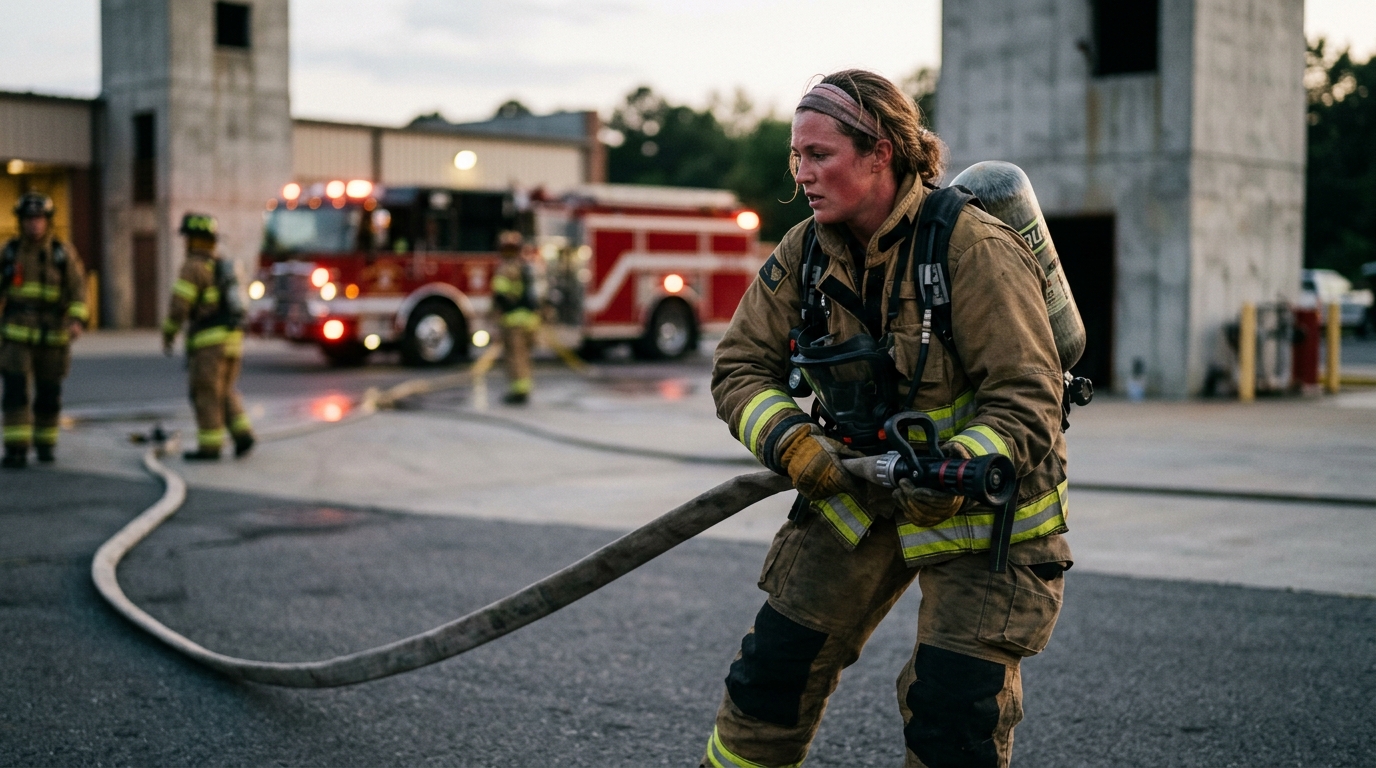
Firefighting is one of the most physically punishing professions on the planet. Every shift can demand that you climb stairs under load, drag charged hose lines, force entry through barriers, and carry victims to safety—all while wearing gear that can weigh well over 50 pounds. Building the right kind of strength and endurance is not optional; it is a career-sustaining necessity.
This ultimate guide breaks down the most effective exercises for firefighter performance, organized by the physical demands of the job, with programming guidance you can apply immediately.
Why Physical Fitness Is Mission-Critical for Firefighters
Firefighters must carry and operate heavy tools, endure extreme heat, and move quickly under unpredictable conditions. Proper physical training directly improves cardiovascular endurance for prolonged exertion, enhances strength and power for lifting and carrying, increases mobility to reduce injury risk, and extends career longevity.
The stakes could not be higher. Cardiac events have been one of the leading causes of on-duty firefighter deaths since 1977, which makes cardiovascular fitness an absolute priority when designing any training program. Additionally, musculoskeletal injuries—strains, sprains, and overexertion—account for a significant share of fireground injuries each year. Research shows that consistent, moderate training doses improve strength, reduce injury risk, and support cardiovascular health far better than occasional high-intensity sessions.
Firefighters who maintain higher levels of physical fitness—including increased VO2max, muscular strength, and muscular endurance—perform better on the job and may reduce their risk of injury. In one study, 81 percent of firefighters already participating in an on-duty training program completed a simulated fireground suppression test faster than those who were not training regularly.
Understanding the Physical Demands: CPAT and Beyond
The Candidate Physical Ability Test (CPAT) is the industry-standard pre-employment physical ability test developed by the IAFF and IAFC. It consists of eight separate events performed continuously within a maximum of 10 minutes and 20 seconds, while wearing a 50-pound weighted vest that simulates the weight of SCBA and protective clothing.
The eight CPAT events are:
- Stair Climb — Performed on a StepMill with an additional 25 pounds on the shoulders, challenging aerobic capacity and lower-body muscular endurance.
- Hose Drag — Tests grip strength, upper-body pulling power, and cardiovascular endurance.
- Equipment Carry — Measures the ability to carry heavy saws and tools across distance.
- Ladder Raise and Extension — Challenges upper-body and lower-body strength, balance, and grip.
- Forcible Entry — Demands explosive upper-body power and core stability.
- Search — Crawling through a confined tunnel that tests agility and composure under stress.
- Rescue Drag — Pulling a weighted mannequin, which challenges aerobic capacity, full-body strength, and grip endurance.
- Ceiling Breach and Pull — Repetitive overhead pushing and pulling that tests upper-body muscular endurance.
Every exercise in this guide maps back to the physical capacities these events—and real fireground tasks—demand: total-body strength, grip endurance, aerobic and anaerobic capacity, trunk stability, and movement quality under load.
Top Strength Exercises for Firefighters
Firefighters need powerful, functional strength that translates directly to the fireground. The exercises below are chosen for their high transfer of effect, scalability, and ability to train multiple planes of motion.
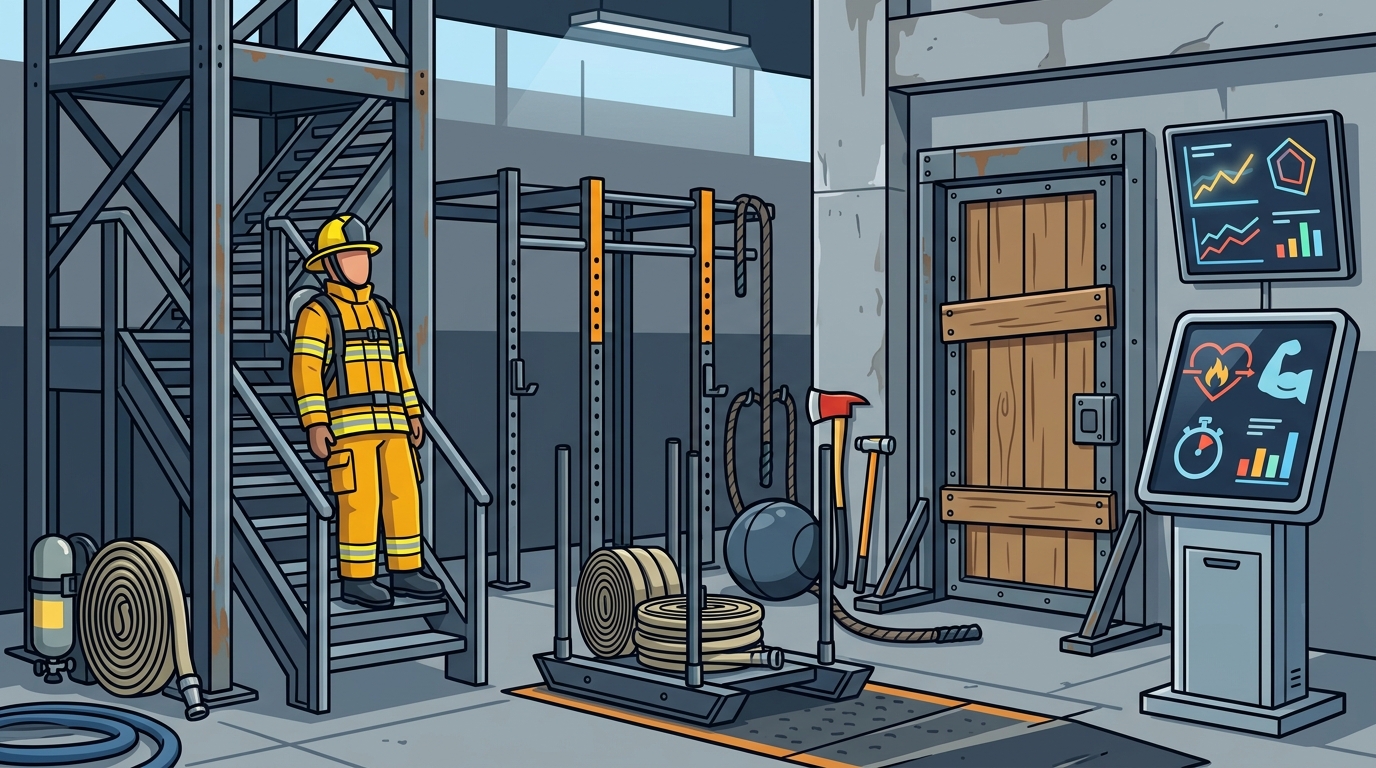
1. Trap Bar Deadlift
Deadlifts build core and lower-body strength essential for moving equipment and victims. The trap bar variation places less stress on the lumbar spine and is easier to learn, making it ideal for fire station gyms with varying experience levels. Work in the 3–5 rep range for maximal strength or 8–12 reps for hypertrophy and endurance.
2. Goblet Squat and Back Squat
Squats are essential for stability, strength, and carrying loads. The goblet squat is an excellent teaching tool and warm-up movement, while the barbell back squat builds the heavy lower-body strength needed for stair climbing under load and victim rescue.
3. Sled Push and Sled Pull
Sled pushes and pulls directly mimic the physical demands of hose drags and victim rescues. They train the posterior chain and anterior chain simultaneously, build work capacity with minimal joint stress, and can be loaded progressively. Use heavy loads for short distances (strength) or moderate loads for longer distances (endurance).
4. Overhead Press (Standing Barbell or Dumbbell)
The overhead press develops the shoulder and triceps strength needed for ladder operations, forcible entry, and the ceiling breach and pull. Standing variations incorporate core stability, making them more functional than seated alternatives.
5. Weighted Pull-Ups
Pull-ups develop the pulling strength necessary for ladder work, halyard pulls, and overhaul tasks. Adding weight once bodyweight reps exceed 10–12 is a straightforward way to continue progressing. Vary grip width and orientation to train multiple pulling angles.
6. Single-Leg Romanian Deadlift
Unilateral posterior chain work addresses asymmetries that poor movement patterns—common in firefighting—can create over time. This exercise builds hamstring strength, hip stability, and balance simultaneously.
Best Endurance and Conditioning Exercises
Firefighting demands both aerobic base fitness and the ability to sustain high-output efforts repeatedly. Training should address both systems.
7. Stair Climbing (StepMill or Real Stairs)
Stair climbing develops leg endurance and cardiovascular strength and is directly relevant to high-rise fire operations. For CPAT preparation, practice on a StepMill at a pace of 50–60 steps per minute while wearing a weighted vest. For general conditioning, climb 10–20 flights at moderate intensity as an aerobic base builder.
8. Rowing Machine Intervals
The rowing machine is one of the best tools for building total-body cardiovascular endurance while reinforcing proper hip-hinge mechanics. Use 500-meter repeats with 90-second rest for anaerobic capacity, or 20–30 minute steady-state rows for aerobic base building.
9. Loaded Rucking
Rucking—walking at pace under load—builds mountain endurance that is especially critical for wildland firefighters but benefits all fire service personnel. Start with 25–35 pounds and work toward 45–50 pounds over varied terrain. Running, rucking, and swimming are each trained as distinct endurance modes in elite tactical programs, with targeted progressions for aerobic base and connective tissue strength.
10. High-Intensity Interval Training (HIIT)
HIIT sessions using assault bikes, battle ropes, or kettlebell complexes replicate the stop-and-go intensity of fireground operations. Protocols like 30 seconds on / 30 seconds off for 15–20 minutes develop the anaerobic power that sustains performance when oxygen is limited and heart rate is spiking.
11. Farmer's Carry
The farmer's carry builds grip and core strength, directly mimicking tool carries to the fire. Walk 40–60 meters per set with the heaviest dumbbells or kettlebells you can hold with good posture. This exercise doubles as a conditioning tool when performed for distance or time.
Core and Trunk Stability Work
Core training should not be an afterthought. It should prioritize movement patterns—extension, flexion, rotation, and anti-rotation—over individual muscles. Exercises should be performed primarily from standing or kneeling positions to integrate the full trunk from thighs to shoulders.
12. Pallof Press (Anti-Rotation)
Using a cable or band, the Pallof press trains the core to resist rotational forces—exactly what happens when swinging a halligan, pulling hose around corners, or working from awkward positions on the fireground.
13. Woodchoppers (Cable or Medicine Ball)
Woodchoppers strengthen the core through diagonal and rotational patterns that mirror forcible entry and overhaul work. Perform both high-to-low and low-to-high variations.
14. Loaded Carry Variations (Suitcase, Overhead, Front Rack)
Asymmetric carries like the single-arm suitcase carry create anti-lateral flexion demands that strengthen the obliques and quadratus lumborum—muscles critical for stabilizing the spine under uneven loads, which firefighters encounter constantly.
15. Turkish Get-Up
The get-up is a total-body exercise that develops agility, shoulder stability, and the ability to move from ground to standing under load. It mirrors the physical demand of getting up from the floor while wearing full PPE and carrying equipment.
Circuit Training: The Fire Station Solution
Many fire departments lack the funding for extensive gym equipment and dedicated training professionals. Circuit training is an ideal solution because it involves minimal rest between exercises, can be performed in a group setting with basic equipment like kettlebells, sandbags, and bodyweight, and stresses both the aerobic and anaerobic systems simultaneously.
Sample Fireground Circuit (25–30 Minutes)
Perform each exercise for 45 seconds, rest 15 seconds, then move to the next. Complete 3–4 rounds with 2 minutes of rest between rounds.
- Kettlebell Swings (power and hip extension)
- Push-Ups (upper-body pushing endurance)
- Goblet Squats (lower-body strength under fatigue)
- Battle Ropes (grip strength and upper-body endurance)
- Sled Pull or Band Rows (posterior chain and pulling strength)
- Step-Ups with Weight (stair-climbing simulation)
This type of circuit delivers concurrent strength and cardiovascular adaptations in a time-efficient format that fits within a duty shift.
Sample Training Week for Firefighters
A balanced program should cover 4–5 training days per week, addressing strength, cardiovascular conditioning, and flexibility. Below is an example framework:
| Day | Focus | Key Exercises |
|---|---|---|
| Monday | Lower-Body Strength | Trap Bar Deadlift, Goblet Squat, Single-Leg RDL, Weighted Step-Ups |
| Tuesday | Upper-Body Strength + Core | Overhead Press, Weighted Pull-Ups, Push-Ups, Pallof Press, Turkish Get-Up |
| Wednesday | Conditioning | StepMill Intervals (20 min), Rowing Machine 500m repeats, Farmer's Carry finisher |
| Thursday | Full-Body Circuit | Fireground Circuit (see above), Mobility and stretching cooldown |
| Friday | Strength + Endurance Hybrid | Sled Push/Pull, Back Squat, Battle Ropes, Loaded Ruck (20–30 min) |
| Saturday | Active Recovery | Light rucking or walking, foam rolling, yoga or mobility flow |
| Sunday | Rest | — |
Key Takeaways
- Prioritize functional movements. Deadlifts, squats, sled work, loaded carries, and pull-ups have the highest transfer to fireground performance.
- Train both energy systems. Aerobic base work (rowing, rucking, stair climbing) and anaerobic intervals (HIIT, battle ropes) are both essential.
- Core training is non-negotiable. Focus on anti-rotation, rotation, and carries rather than endless crunches.
- Circuit training is ideal for fire stations. It builds strength and cardio simultaneously with minimal equipment and time.
- Consistency beats intensity. Training 4–5 days per week with moderate, well-programmed sessions outperforms sporadic extreme workouts.
- Train for the job, not for aesthetics. Every exercise should serve a purpose connected to fireground tasks or CPAT events.
Frequently Asked Questions
What is the best single exercise for firefighters?
If you could only do one exercise, the trap bar deadlift offers the greatest return. It builds lower-body and core strength that transfers directly to lifting equipment, dragging hose, and moving victims. However, no single exercise is sufficient—firefighters need a balanced program covering strength, endurance, and core stability.
How often should firefighters work out?
Most experts recommend 4–5 days per week, incorporating a mix of strength, conditioning, and flexibility work to maintain peak physical performance. Include at least one full rest day and one active recovery day.
Can I train effectively with no gym equipment?
Yes. Push-ups, lunges, step-ups, crawling, bodyweight squats, and get-ups can all be performed with minimal or no equipment. Sandbags and kettlebells are inexpensive additions that dramatically expand your options.
How does firefighter training differ from general fitness?
Firefighter training emphasizes functional, job-specific capacity over aesthetics. Workouts are designed around actual fireground movements, building repeatable power under stress with limited air, awkward loads, and unpredictable footing. General fitness programs often lack this specificity.
What are the eight CPAT events?
The CPAT consists of eight events: stair climb, hose drag, equipment carry, ladder raise and extension, forcible entry, search, rescue drag, and ceiling breach and pull. All must be completed continuously within 10 minutes and 20 seconds while wearing a 50-pound vest.
Is cardio or strength more important for firefighters?
Both are essential and should not be traded against each other. Strength ensures firefighters can carry heavy equipment and lift people to safety, while endurance is critical because fires do not stop when you are tired. A well-designed program trains both systems concurrently.