
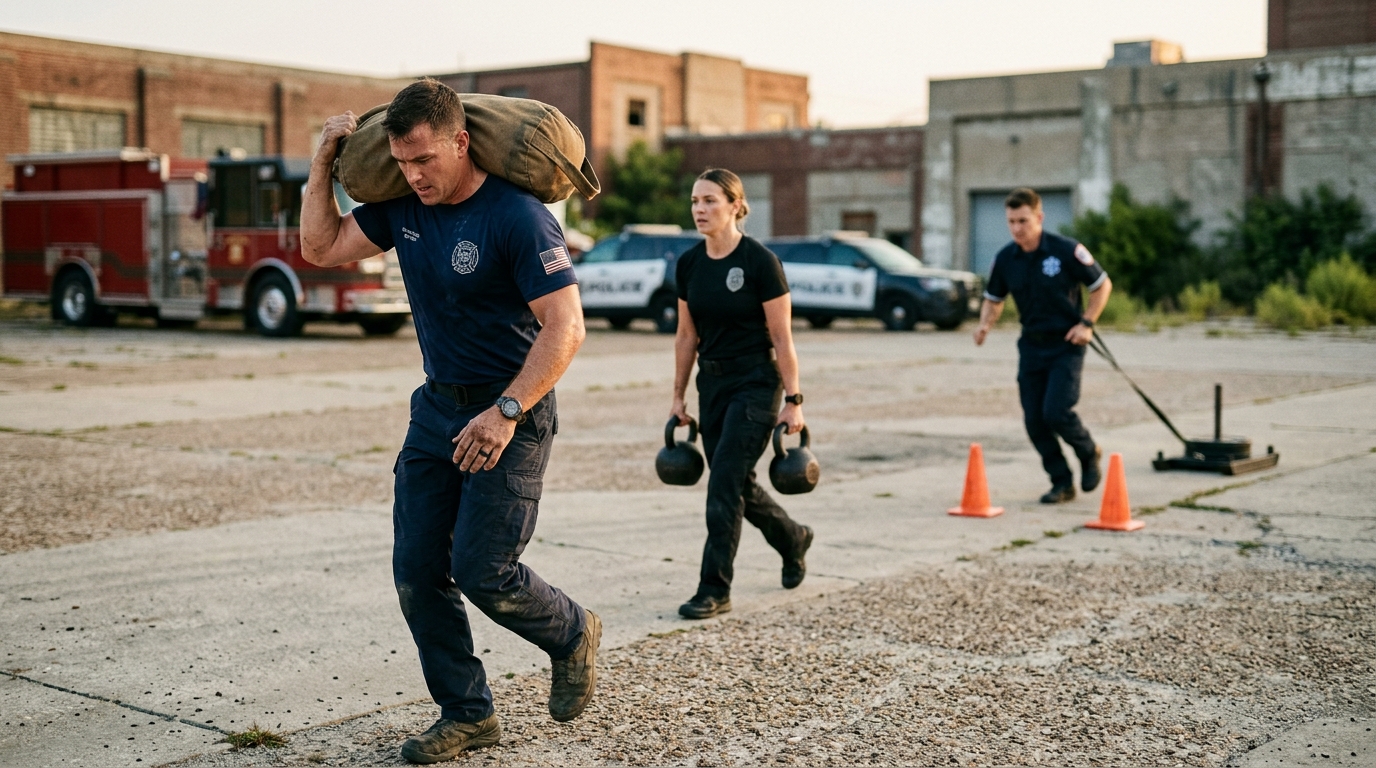
A shift can go from zero to life-or-death in seconds. One minute you are seated in a patrol car or posted at the station; the next you are hauling charged hose line up a stairwell, performing chest compressions on an overpass, or sprinting after a fleeing suspect. Standard gym routines built around mirror muscles and treadmill jogs do not prepare you for that kind of demand. This guide presents a complete system—periodized strength work, energy-system conditioning, mobility practice, nutrition strategy, and recovery protocols—built specifically for firefighters, law enforcement officers, EMTs, and paramedics.
Why First Responders Need a Different Training Model
A civilian gym program typically focuses on aesthetics—building muscle or losing weight with isolated movements. A tactical fitness program is built for performance: strength, endurance, mobility, and the ability to operate under stress. The goal is not to look fit but to perform when it matters most.
First responders have some of the most physically demanding tasks in society. While specific duties vary by role, many require maximal or near-maximal physical exertions over brief as well as extended periods of time, often in unpredictable and rapidly changing environments where personal safety is at risk. That is why first responders are frequently referred to as tactical athletes.
The problem is that once past the academy, maintaining a consistent fitness program becomes challenging. Most of a first responder's shift time is actually sedentary. This can lead to a steady decline in health and fitness over the occupational life span unless proactive measures are taken. Physical fitness—including strength training and conditioning—is a perishable skill.
The Five Pillars of Tactical Fitness
Effective first responder programming addresses five distinct but overlapping training qualities. Neglect any one of them and you create a gap that the job will eventually exploit.
Pillar 1: Foundational Strength
Compound, multi-joint lifts are the backbone of occupational readiness. Deadlifts engage the entire posterior chain and directly improve your ability to lift and carry. Front and back squats build the lower-body power necessary for sprinting, jumping, and bearing loads. Pull-ups strengthen the back and biceps for climbing and pulling. The overhead press develops shoulder and core strength for pushing and stabilizing heavy objects.
Focus on moderate-to-heavy loads with lower repetitions (three to five reps per set) to develop maximal strength—the kind of raw force required when you need to move a downed colleague or force a jammed door.
Sound periodization is essential. Training should follow a developmental hierarchy: first build stability, then strength, and finally power. Violating this progression increases injury risk and limits long-term development.
Pillar 2: Energy-System Conditioning
Tactical endurance is not a 30-minute jog. It requires both aerobic and anaerobic conditioning so you can perform at high intensities for extended periods while wearing heavy gear.
An effective program sets a solid cardiovascular base and then layers in interval training. Intervals are one of the best ways to simulate the unpredictable work-rest ratios of the fire ground, a foot pursuit, or a prolonged patient extrication. Alternate between high-intensity interval sessions and longer, steady-state cardio workouts to develop comprehensive endurance.
- Aerobic base: 30–45 minute runs, rucks, or bike sessions at a conversational pace, two to three times per week during base-building phases.
- Anaerobic intervals: 1-mile repeats, 400-meter sprints, sled pushes, or Assault-bike Tabatas performed once or twice weekly.
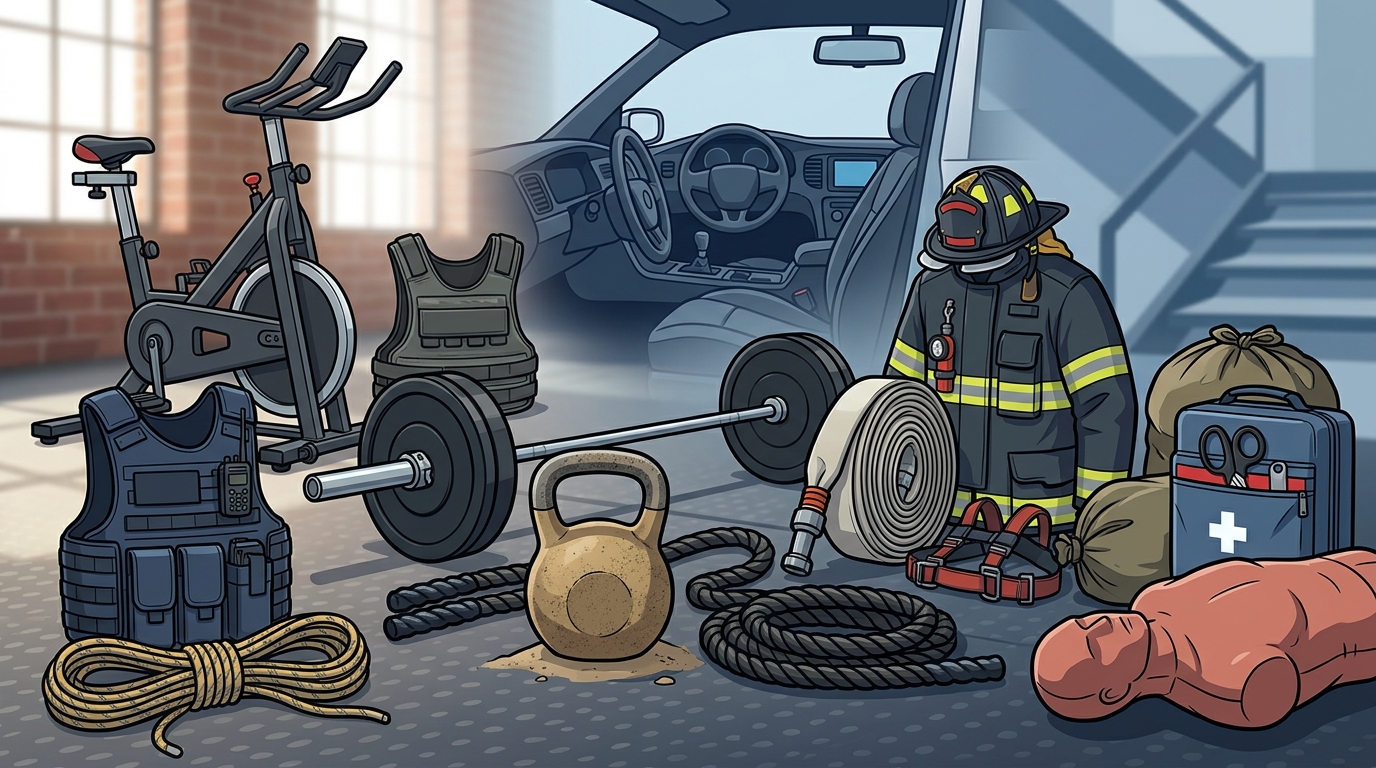
- Loaded conditioning: Ruck marches or weighted vest walks to build load-bearing capacity specific to duty gear.
Pillar 3: Mobility and Injury Prevention
Many first responders deal with lower back pain, knee issues, and shoulder strain—often due to years of repetitive motion and sudden physical demands. Dynamic stretching and mobility work—hip openers, thoracic rotations, shoulder dislocations—should be embedded into every warm-up. The more flexible the muscle and joint, the better you recover and the lower your injury risk.
Every session should begin with an active warm-up that boosts heart rate, blood flow, and core temperature while priming the nervous system. Think of it as warming up a car that has been sitting in the cold all night before asking it to accelerate.
Pillar 4: Nutrition as Fuel
You cannot out-train a bad diet. Fitness progress happens in the gym and the kitchen. First responders who eat quickly at odd hours face unique metabolic challenges. Preparing meals in advance, monitoring added sugars, staying hydrated, and controlling portions are non-negotiable habits.
Plan a scheduled indulgence meal each week to avoid burnout. Treat food for its primary purpose: providing energy and building material for a body that must perform on demand.
Pillar 5: Recovery and Mental Resilience
Short bouts of targeted physical activity have been shown to lower cortisol levels, reduce anxiety symptoms, and improve mood by triggering the release of endorphins, dopamine, and serotonin. This means that even brief movement between calls is not just a physical benefit—it is a mental health strategy.
Quality sleep, structured rest days, foam rolling, and breathing drills are not optional extras. They are force multipliers that determine whether your training gains survive the grind of a 48-hour rotation.
A Concurrent Training Framework: Sample Weekly Schedule
The schedule below uses a concurrent model—training multiple fitness attributes within the same week—which research supports as the most practical approach for tactical populations with chaotic schedules.
| Day | Focus | Example Session |
|---|---|---|
| Monday | Max-Strength Lower | Back squat 5×3, Romanian deadlift 4×5, weighted step-ups 3×8 each leg, plank variations 3×30 s |
| Tuesday | Aerobic Base + Mobility | 35-min steady-state run or ruck, followed by 15 min hip and thoracic mobility flow |
| Wednesday | Max-Strength Upper | Bench press 5×3, weighted pull-ups 4×5, overhead press 3×6, Pallof press 3×10 each side |
| Thursday | Active Recovery | 20-min walk, foam rolling, diaphragmatic breathing |
| Friday | Power-Endurance Circuit | Kettlebell swings, box jumps, sled push, assault bike—5 rounds, 40 s work / 20 s rest per station |
| Saturday | Loaded Conditioning | Ruck march 4 miles at 35 lb, or sandbag carry complex |
| Sunday | Rest | Full rest or light stretching |
This template is intentionally modular. If a shift blows up your Tuesday and Thursday, compress the week into three priority sessions (Monday, Wednesday, Friday) and sprinkle micro-exercises through your on-duty hours.
Micro-Exercises: Staying Ready Between Calls
Not every training adaptation requires a gym. Research shows that short bouts of light activity—especially after meals—can help regulate blood sugar and reduce insulin spikes. For first responders who eat quickly at odd hours, micro-exercises play a key role in stabilizing energy levels and long-term metabolic health.
Micro-exercises also strengthen stabilizing muscles and improve mobility, helping prevent the most common on-duty injuries. Here are practical examples you can do anywhere on shift:
- Seated in a patrol car or ambulance cab: Alternate leg lifts, 10-second glute squeezes (5–10 reps), seated torso twists.
- Standing at the station: Bodyweight squats, calf raises on a step, banded pull-aparts.
- Between calls: 2-minute plank, 20 push-ups, 30-second wall sit.
Set a personal target—like five micro-exercises per shift—and log each one. If you thrive on friendly competition, challenge your partner or crew to see who logs the most during the week. When supervisors make movement a visible priority, it sends a message that fitness, wellness, and long careers are part of team culture.
Training by Role: Tailoring the Template
Firefighters
Firefighters benefit from extra emphasis on anaerobic capacity and grip strength. Hauling a charged hose line, axing open a roof, and performing primary searches all demand repeated high-output efforts with incomplete recovery. Add farmer carries, sledgehammer strikes on a tire, and hose-drag simulations to the Friday power-endurance circuit.
Law Enforcement Officers
Officers need explosive sprint speed, grappling strength, and the ability to transition from prolonged sitting to sudden all-out effort. Incorporate short shuttle runs, hip-escape drills, and heavy sandbag-to-shoulder movements. Upper-body strength training provides critical musculoskeletal bracing under the weight of a Kevlar vest worn for 10–12 hours.
EMTs and Paramedics
Patient lifting, prolonged kneeling, and awkward-angle carries define the EMS workload. Prioritize single-leg exercises for balance under asymmetric loads, thoracic spine mobility for extended time bent over a patient, and posterior chain work to protect the lower back during stretcher lifts.
Time-Efficient Methods That Actually Work
Tactical athletes often lack time for ideal training sessions. When coaching these professionals it is important to use time-efficient methods due to the uncertainty of training schedules. Here are proven strategies that fit within a 30–45-minute window:
- Cluster Sets: Break a heavy set of 6 into 3 mini-sets of 2 with 15–20 second intra-set rest. You maintain load quality while compressing total session time.
- EMOM (Every Minute on the Minute): Perform a set at the top of each minute for a fixed time block. This autoregulates rest and keeps sessions moving.
- Supersets with Opposing Muscle Groups: Pair bench press with barbell rows to cut rest time in half while maintaining performance on both lifts.
- Density Blocks: Set a 12-minute timer and complete as many quality rounds of 3–4 exercises as possible. Track total rounds to measure progress over weeks.
A simple, sound, and scalable training program will work better than you think, especially for those who do not have a high training age. Just having structure beats random workouts every time.
Benchmarks Worth Chasing
Goals give your training direction. Here are evidence-informed performance targets appropriate for a well-conditioned first responder:
| Metric | Target | Why It Matters |
|---|---|---|
| Deadlift | 2× body weight | Posterior chain strength for lifting and carrying |
| Front Squat | 1.5× body weight | Lower-body power under load |
| 1.5-Mile Run | Under 10:30 | Aerobic baseline for sustained effort |
| Pull-Ups | 15+ strict | Climbing, pulling, and upper-body endurance |
| Loaded 3-Mile Ruck (35 lb) | Under 42 min | Load-bearing endurance in duty gear |
| Plank Hold | 90+ seconds | Core stability under fatigue |
Test these benchmarks every 8–12 weeks. Progress is motivating, and retesting reveals which pillar needs more attention in the next training block.
Building a Culture of Fitness in Your Department
Individual effort is powerful, but systemic support multiplies results. Many agencies now use a Peer Fitness Leader (PFL) approach where a trained department member leads physical training. PFL program designs have been reported effective in improving physical activity participation, reducing work-related injuries, and lowering associated costs.
Despite the known importance of fitness, adequate resources and programming to benefit first responders are often not prioritized, and training across academies and careers is frequently inconsistent. If your department does not have a formal program, start small: organize a twice-weekly crew workout, post a movement challenge on the station whiteboard, and connect with organizations like the First Responder Center for Excellence that provide free evidence-based resources.
Key Takeaways
- Train like a tactical athlete, not a bodybuilder. Prioritize compound movements, energy-system conditioning, and mobility over muscle isolation.
- Use periodization: build stability first, then strength, then power. Do not skip steps.
- Alternate high-intensity intervals with steady-state cardio to cover both aerobic and anaerobic demands.
- Micro-exercises between calls maintain metabolic health, reduce injury risk, and support mental resilience.
- Tailor the template to your specific role—firefighting, law enforcement, or EMS each have distinct physical priorities.
- Time-efficient methods like EMOM sets, cluster sets, and supersets let you train effectively in under 45 minutes.
- Test benchmarks every 8–12 weeks to measure progress and adjust programming.
- Advocate for a department-level fitness culture—peer-led programs have measurable impact on participation and injury reduction.
Frequently Asked Questions
Why are first responders called tactical athletes?
First responders are called tactical athletes because their occupations demand maximal physical output in unpredictable, high-risk environments. Unlike sport athletes who peak for competitions, tactical athletes must maintain broad readiness every single shift.
How many days per week should a first responder train?
Three to five structured sessions per week is the most common recommendation in tactical fitness programming. If your shift schedule only allows three days, focus on one lower-body strength session, one upper-body strength session, and one conditioning session, then supplement with micro-exercises on duty.
What is the best training split for a first responder?
A concurrent model—training strength, conditioning, and mobility within the same week—works best for unpredictable schedules. A practical split includes two strength days, one power-endurance circuit, one steady-state cardio session, and one active recovery day.
Can first responders train effectively at the station?
Absolutely. A kettlebell, a pull-up bar, and a weighted vest provide enough equipment for a complete tactical fitness session. Many departments have achieved excellent results with minimal station-based setups.
How do I balance strength training with endurance without losing gains?
Separate heavy lifting and long cardio by at least six hours when possible. Keep strength sets heavy but low-volume to minimize fatigue carryover. Use block periodization to emphasize one quality per phase while maintaining the other at reduced volume.